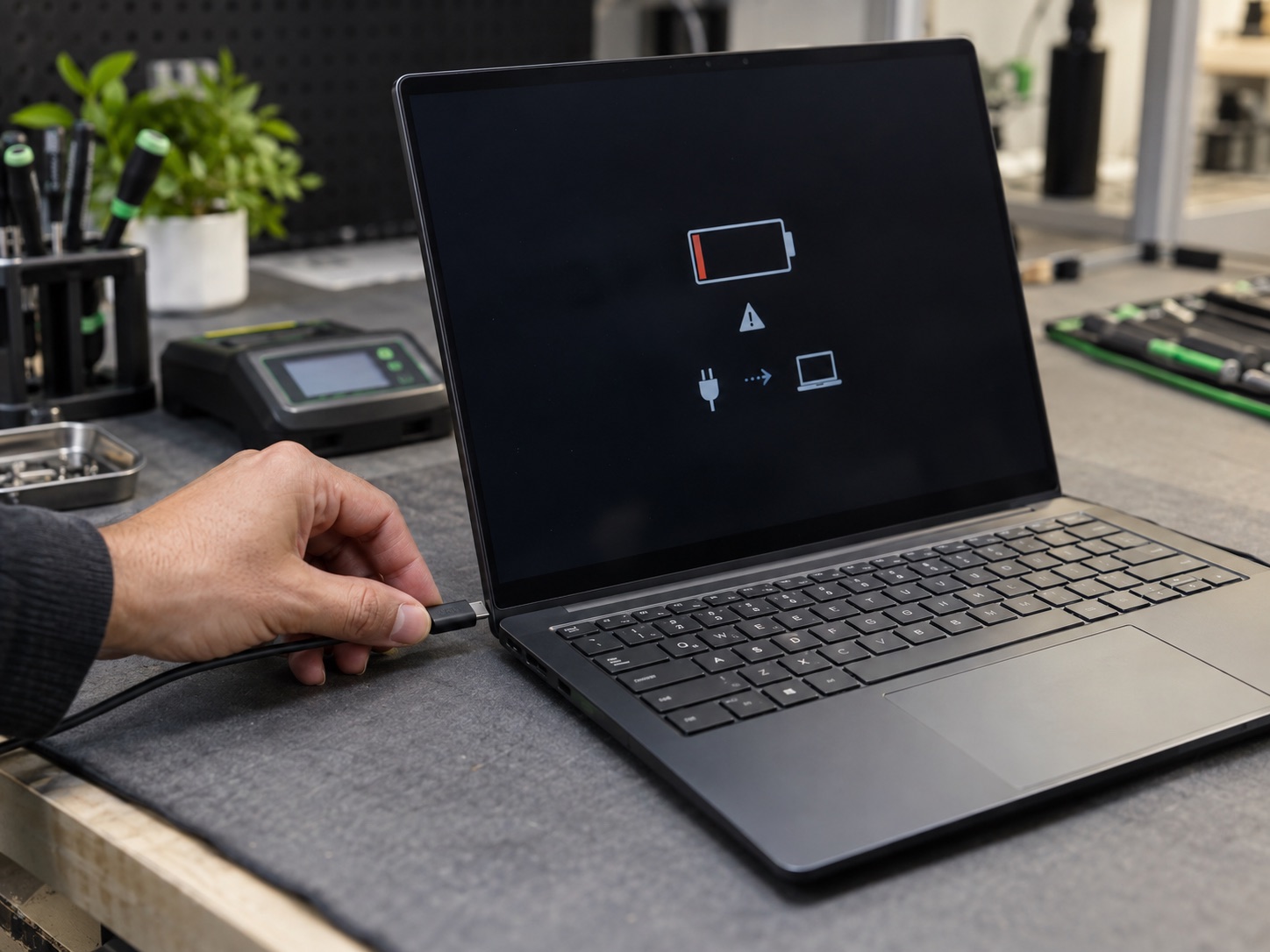


Hot laptop, loud fans, frame rates falling half an hour into a game. What actually causes computer overheating, the temperatures worth worrying about, the fixes that work, and the point at which heat has already damaged the hardware.
Heat is the quiet killer of computers. Nothing dramatic happens on the day a cooling system stops keeping up. The machine simply gets slower under load, the fans get louder, games start stuttering half an hour in, and the battery loses a little capacity every week. Months later that same machine arrives at our bench in Hendersonville with a fault that reads like a board problem, and the real story turns out to be two years of dust and dried thermal paste.
The encouraging part is that overheating is one of the most fixable faults in the trade. Almost every hot computer we open falls into a short list of causes, and most of them come down to cleaning, paste and parts rather than anything exotic. This guide covers the temperatures that actually matter, how to tell real overheating from a different problem wearing the same costume, what you can do at home, and where the line sits between a worthwhile service and a machine heat has already ruined.
How To Tell It Is Actually Overheating
- Fans run loud and constant even when the machine is doing very little.
- The chassis is hot to the touch, especially around the vents and above the keyboard.
- Performance falls exactly when the work ramps up, which is thermal throttling doing its job.
- Games stutter or crash after fifteen to thirty minutes rather than immediately.
- The machine shuts itself off under load with no warning and no error, which is the hardware's last line of self defense.
- Fan noise rises and falls in a cycle every few seconds instead of settling at one steady speed.
- The laptop is fine on a desk and unbearable on a lap, a bed or a couch.
That mid-session pattern is the signature worth learning. Cold hardware benchmarks perfectly, temperatures climb for twenty minutes, the system cuts its own clock speed to stay within limits, and frame rates fall off a cliff at exactly the moment the action gets heavy. A machine that is slow from the first second after boot is usually a storage or software problem instead, and that is worth ruling out before anybody opens a case.
Thermal Throttling Versus Thermal Shutdown
Modern hardware defends itself in two stages, and knowing which stage you are watching tells you how urgent the problem is. The first stage is throttling. When a processor reaches its thermal limit it drops its clock speed and its voltage, sheds heat, and carries on working at reduced performance. Nothing warns you. There is no message, no beep, and no log entry an ordinary owner would ever see. All you notice is that the machine got slower, which is why most people blame the software, blame an update, or quietly decide the computer is getting old.
The second stage is shutdown. If the temperature keeps climbing past the throttle point, usually somewhere around 100 to 105 Celsius on the processor die, the hardware cuts power instantly to protect itself. No shutdown sequence, no save prompt, no error, just black. That is not the computer failing. That is the last safety mechanism in the chain doing precisely what it was built to do. A machine that dies cold under load and then boots perfectly after ten minutes sitting on a desk has already told you what is wrong in plain language.
The distinction matters because throttling is the stage where a service is cheap and shutdown is the stage where people finally book one. A computer that has quietly given up a third of its performance for a year has also been holding its battery, its storage, its capacitors and its power delivery circuitry at temperatures they were never meant to live at for that long. The shutdown is not the beginning of the problem. It is the end of a long one.
The Temperatures That Actually Matter
Most people either panic at numbers that are completely normal or shrug at numbers that are not. Silicon runs hot by design, and a CPU touching 85 Celsius during a video export is behaving exactly as its engineers intended. What matters is where the temperature sits during sustained load, not the peak it brushes for one second.
| Component | Idle | Normal under load | Investigate above |
|---|---|---|---|
| Desktop CPU | 30 to 45 C | 60 to 80 C | 90 C sustained |
| Laptop CPU | 40 to 55 C | 75 to 90 C | 95 C sustained |
| GPU core | 35 to 50 C | 65 to 85 C | 90 C sustained |
| GPU hotspot or junction | 45 to 60 C | up to 95 C | 105 C, or a 25 C gap to the core |
| NVMe SSD | 35 to 50 C | 55 to 70 C | 75 C sustained |
| Laptop battery | near ambient | under 45 C | 50 C, where capacity loss accelerates |
Modern chips defend themselves near their limit, commonly 95 to 105 Celsius, by throttling first and shutting down second. Touching that ceiling is not an emergency on its own. Living there for hours a day is what shortens the life of everything around it.
Measure it properly or you are guessing. Touching the chassis tells you very little, because a plastic case can feel alarming while the silicon underneath is comfortable, and an aluminum MacBook can feel merely warm while the processor sits at its ceiling. A free monitoring utility settles the question in twenty minutes.
How To Read The Numbers Without Fooling Yourself
- 1Install a free monitoring utility that logs to a file rather than one that only shows a live readout, because the number you need is an average over time and nobody can watch a graph for twenty minutes.
- 2Reproduce the real workload. The game that stutters, the export that crashes, the twelve browser tabs and the video call. A synthetic stress test is useful for confirming a fix but it is not what your computer actually does.
- 3Let it run a full twenty minutes, then read the sustained figure rather than the maximum. The first five minutes of any test look fine on a machine that is about to shut down, and a single 97 degree spike during a load transition is normal where twenty minutes averaging 97 is not.
- 4Log fan speed next to temperature. A processor at 95 Celsius with the fans at 2,000 RPM is a cooling failure. The same temperature with the fans at their ceiling is a cooling system that is simply outmatched, and those two situations need different fixes.
- 5Note the room. Subtract the ambient temperature from your idle reading. If a desktop idles 25 degrees above the room it is in, the cooling is already compromised before any work starts.
One number deserves extra attention on a graphics card, and almost nobody looks at it. Alongside the core temperature, modern cards report a hotspot or junction figure taken from the hottest single point on the die. On a healthy card the gap between the two sits around ten to fifteen degrees. Once that gap opens past twenty five degrees, the thermal interface between the die and the cooler has degraded or the cooler is no longer sitting flat against it, and no amount of extra case airflow will close it. That delta is the single most reliable signal we have that a card needs to come apart rather than be dusted off.
Why Computers Overheat
1. Dust, Which Is Still The Biggest One
Fans move air, air carries dust, and inside a heatsink that dust does not sit loose. It packs into the fin stack like felt, right at the exit where the fan pushes air through, and once that mat forms the fan can spin at full speed while moving almost nothing. This is the most common cause on our bench by a wide margin. Carpet, pets and smoking all accelerate it, and so does a desktop standing on the floor, because the intake is then eighteen inches from where everything settles. A laptop that has never been opened in four years is usually carrying a solid grey pad you can lift out in one piece.
2. Thermal Paste That Has Dried Or Pumped Out
The compound between the processor and its cooler exists to fill microscopic gaps, and it degrades. On a desktop it dries and cracks over roughly three to five years. On a laptop it also pumps out, meaning thousands of heating and cooling cycles squeeze it sideways off the die until the center of the chip is running against a dry patch. The signature is different from dust: temperatures spike within seconds of load rather than climbing slowly, and the fans and vents look perfectly clean. Repasting is routine work and one of the largest single improvements available on an older machine, which is why it gets a section of its own further down this page.
3. Blocked Airflow And Where The Machine Lives
Laptop intakes are on the bottom, so a bed, a couch or a lap seals them and the machine slowly cooks in air it has already used. Desktops pushed into a closed cabinet or pressed against a wall do the same thing at a larger scale, recirculating their own exhaust until the intake air is warm before it even reaches a heatsink. Ambient temperature is part of the same problem, and in a Middle Tennessee summer a garage office or a west-facing room can add ten degrees to every reading before the computer has done any work at all. This is the cause that costs nothing to fix and gets ignored more than any other.
4. A Fan, Pump Or Heat Pipe That Has Failed
Bearings wear out. A fan that rattles, buzzes, spins up unevenly or has gone suspiciously quiet is no longer moving the volume of air the cooling system was designed around. On a liquid cooled desktop the failure point is the pump: coolant temperature climbs while the radiator fans do nothing useful, and the CPU reaches its ceiling in under a minute. Heat pipes fail less often but they do fail, usually after a hard knock, and a dented pipe carries almost no heat at all. Any of these ends in a shutdown under load, which owners reasonably mistake for a computer that will not stay on.
5. Software Holding The Hardware At Full Load
Sometimes the heat is the symptom rather than the fault. Cryptomining malware, a browser tab stuck in a loop, a failed update retrying forever, a photo indexer chewing through a freshly imported library, or a game launcher quietly patching itself will all hold the processor at full load for hours. The tell is a machine that is hot and loud while you believe it is idle. Open Task Manager on Windows or Activity Monitor on a Mac, sort by CPU, and see what is actually running before blaming the cooling. If something you do not recognize is sitting at the top of that list, a malware scan comes before a screwdriver.
6. Hardware Asked To Do More Than It Was Built For
A stock cooler on an overclocked processor, a small form factor case given a full size graphics card, or a thin ultrabook running a four hour video export are all cooling systems working outside their design. Nothing is broken in those cases and no amount of cleaning helps, because the heat being produced is simply more than the hardware can move. The answer is a better cooler, a different case, or accepting the throttling. It is also the most common reason a bargain gaming laptop disappoints its owner: the components are genuine, and the cooling is where the money was saved.
7. It Was Never Overheating At All
Two or three times a month a machine arrives that turns out to be running fine. An aggressive default fan curve makes a healthy desktop sound like it is in distress. A failing sensor reports 100 degrees while the chip is cool to the probe. A dying power supply causes shutdowns under load that look exactly like thermal protection, and so does failing RAM, which tends to announce itself with a blue screen rather than a silent cut. Measuring first is what separates all of these from each other, and it takes ten minutes.
Laptops Overheat For Reasons Desktops Do Not
A desktop has room to be wrong. A laptop does not. Inside a thin chassis the cooling system is a single copper heat pipe assembly, one or two small fans running at high speed, and a fin stack a few millimeters deep sitting behind a vent that is often partly covered by the hinge. There is no margin anywhere in that design. Lose a quarter of the airflow to dust and the whole thing falls over, which is why a laptop notices neglect years before a desktop does.
On most gaming and workstation laptops the processor and the graphics chip share the same heat pipes and the same fin stack. That single design decision explains a fault people find baffling: the CPU sits at 95 Celsius during a game that is barely using it, because the graphics chip next door is dumping its heat into the same copper. Fixing that means servicing the whole cooling assembly, not just the side that shows the alarming number. It is also why a laptop with two fans can lose one and keep running badly for a year while its owner assumes it always sounded like that.
Then there is where the air comes from. Laptop intakes sit on the underside, a set of grilles a few millimeters above the desk, and sealed by a bed, a cushion or your legs the fan recirculates the machine's own exhaust, temperatures climb fifteen to twenty degrees, and the chassis gets hot enough that customers arrive convinced the battery is failing. Nine times out of ten the fix is a hard flat surface and a clean fin stack.
MacBooks deserve a note of their own. The aluminum body is part of the cooling system, which means a warm chassis is normal and not in itself a sign of trouble, and the fanless MacBook Air is designed to throttle rather than to stay fast. Apple silicon runs far cooler than the Intel generation before it, but Intel MacBooks from roughly 2016 to 2020 remain the hottest laptops we routinely see, and they respond extremely well to a proper strip-down. If you own one, a clean and repaste is the single best value Mac repair available, and it usually costs less than the AppleCare deductible people expect to pay.
Desktops Overheat For Reasons Laptops Do Not
A desktop rarely overheats because the cooler is too small. It overheats because the case is not moving air through it. Airflow in a tower is a system: cool air in at the front and bottom, hot air out at the rear and top, in roughly balanced volumes. Break that and every individual part can be perfectly healthy while the machine cooks. The most common version we see is a case with a solid glass or brushed metal front panel and a two millimeter slot down each side for intake, which looks superb and starves three hundred watts of hardware of the air it needs.
The graphics card is usually the real heat source, not the processor, and in most towers it hangs in the middle of the case with its cooler pointed at the floor of the chassis. An open-air card recycles its own exhaust straight back into the case and pushes the CPU and the drives up with it. Two cards, or a card mounted directly above the power supply shroud, makes it worse. If the CPU temperature only misbehaves during gaming and behaves perfectly during a CPU stress test, the graphics card is heating the room the processor lives in.
Liquid cooling adds its own failure modes. An all in one cooler mounted with the radiator below the pump collects an air pocket at the pump inlet, and that pocket produces a rattle at idle and a processor that hits its limit within a minute of load while the radiator stays cool to the touch. Pumps also simply wear out, typically after five to seven years, and a dead pump looks exactly like a dead cooler. On the air side, the tell is a heatsink that is hot at the base and cool at the top of the fin stack, which means the heat pipes have lost their working fluid.
Finally, position. A tower standing on carpet has its bottom intake filter pressed into the pile and pulls in carpet fiber all day. A tower in a closed desk cabinet breathes its own exhaust. A tower pushed flat against a wall has nowhere to send the rear exhaust. Four inches of clearance behind the case and a hard surface underneath it costs nothing and is frequently worth more than a cooler upgrade. When we build a custom gaming computer we treat case airflow as a component with a budget line, because it is the part that decides whether the rest of the money was well spent.
Thermal Paste: What It Really Does And How Long It Lasts
Two machined metal surfaces pressed together are not flat. Under magnification the base of a cooler and the lid of a processor are a landscape of ridges and hollows, and the gaps between them fill with air. Air is one of the best insulators in the building, which is why a cooler bolted down onto a bare chip performs worse than no cooler at all in some cases. Thermal paste exists to fill those microscopic voids with something that conducts, and the layer doing that work is typically less than the thickness of a human hair.
It has two ways of failing and they look different on the bench. The first is dry-out: the carrier oils evaporate over years, the compound turns chalky, and it cracks away from the die. That is a slow, gradual temperature creep and it is the desktop pattern. The second is pump-out, and it is the laptop pattern. Every heat cycle expands and contracts the metal on both sides slightly, and over thousands of cycles that motion squeezes the paste outward from the center of the chip until the hottest point on the die is running against a dry patch with a ring of dried compound around it. Pump-out gives you the signature people describe as sudden: fine at idle, 100 Celsius in four seconds, fans clean, vents clear.
| Interface material | Realistic service life | Where it belongs | What we have learned about it |
|---|---|---|---|
| Budget silicone paste | 2 to 3 years | Office desktops and cheap builds | Dries and cracks first, but it is cheap and easy to replace |
| Quality ceramic or metal oxide paste | 4 to 6 years in a desktop | The majority of repairs | The sensible default, and the difference from budget paste is a few degrees |
| The same paste inside a laptop | 2 to 4 years | Thin laptops and gaming laptops | Heat cycling pumps it out long before it dries out |
| Factory phase change pad | 5 years or more | Some OEM laptops and coolers | Needs heat to seat properly, and should be replaced like for like |
| Liquid metal | 3 to 5 years if applied correctly | Enthusiast desktops and a few gaming laptops | Electrically conductive and it eats aluminum coolers, so not a first repaste |
| Thermal pads on VRM and memory | Replace whenever the paste is replaced | Graphics cards and laptops | Wrong pad thickness is worse than the tired pad you took out |
These are service lives, not warranties. A machine that runs eight hours a day at high load ages its paste faster than one that checks email, and heat cycling matters more than total hours.
The part home repasting gets wrong is almost never the brand of the paste. It is the amount and the pads. Too little leaves the corners of the die dry, too much insulates rather than conducts and squeezes out onto the socket, and on a graphics card or a laptop the thermal pads over the memory and the power delivery stage matter as much as the paste over the chip. Fit a pad a millimeter too thin and the cooler no longer touches the die at all. Fit one a millimeter too thick and it holds the cooler off the die like a spacer. We keep pads in several thicknesses on the bench for exactly this reason, and it is the main thing that separates a repaste that works from one that made things worse.
What a repaste is worth in numbers: on a four or five year old laptop that has never been opened, a full clean and repaste routinely takes fifteen to twenty five degrees off the sustained load temperature, and the performance that comes back with it is the performance the machine had when it was new. On a desktop the gain is usually smaller, five to twelve degrees, because desktops have more thermal headroom to lose before anyone notices. Either way it is the cheapest large performance improvement available on an aging computer, and it is not close.
What You Can Do Today Without Opening Anything
Before any tools come out, there is a short list of free changes that solve a real share of the hot machines people write to us about. Work through it in order and measure again afterward, because knowing that none of it helped is genuinely useful information to arrive with.
- 1Put the laptop on a hard flat surface and raise the back half an inch on anything solid. Opening the underside intakes is the most effective free change available, usually worth three to six degrees on its own.
- 2Give a desktop four inches of clear space behind and above it, get it off carpet, and open the cabinet door it is hiding in.
- 3Open Task Manager on Windows or Activity Monitor on a Mac, sort by CPU, and look at what is running when you believe the machine is idle. Anything holding thirty percent or more with no window open is the problem, not the cooling.
- 4Update the graphics driver and the system firmware. Fan curve and power limit behavior lives in firmware, and a bad revision genuinely can cook a machine until it is patched.
- 5Cap the frame rate in games to your monitor's refresh rate. Rendering 300 frames a second on a 144 Hz screen produces heat and nothing else.
- 6On Windows, set the power plan to Balanced rather than High Performance and, on laptops, set the maximum processor state to 99 percent. That disables turbo boost and frequently trades three percent of performance for fifteen degrees.
What Does Not Work
- A cooling pad under a clogged laptop. On a clean machine a thirty dollar fan pad is worth one to three degrees, which is real but small. On a laptop whose fin stack is packed solid it does nothing at all, because the limit is inside the machine and not underneath it.
- A vacuum cleaner inside a computer, or compressed air with the fan left free to spin. The nozzle generates static as air moves across it, and static is the one thing on a board that kills silently and permanently. A free spinning fan becomes a generator whose bearing runs far past its rated speed, and we regularly see fans that started rattling the week after a well meant cleaning.
- Undervolting or a custom fan curve used to hide a hardware problem. Both are legitimate tuning on a healthy machine and neither one removes a gram of dust.
- Running a desktop with the side panel off permanently. It disrupts the intended path through the case, and it turns the inside of your computer into a dust collector.
- Anything involving a fridge, a freezer, an ice pack or a bag of silica. Cooling a machine below the dew point condenses water inside it, and now you have two faults.
- Waiting. Heat damage is cumulative and it does not reverse when the machine finally gets cleaned.
The Mistake People Make
Treating the shutdown as the moment the problem started. By the time a computer is cutting power under load, it has usually spent a year or more throttling quietly, and everything heat-sensitive around the processor has been aging fast the whole time. The customers who come out of this cheapest are the ones who booked a service when the fans got loud, not the ones who waited until the machine turned itself off mid-game. A cooling pad bought instead of a cleaning is the same mistake with a receipt attached.
When Heat Has Already Damaged The Machine
Silicon does not fail at a temperature. It ages at a rate, and that rate roughly doubles for every ten degrees. A processor held at 95 Celsius for hours a day is not being destroyed today, it is being given the wear of several years in one. What that produces in practice is a chip that becomes unstable at the clock speeds it used to hold, so the machine starts crashing under load long before it ever refuses to boot. Owners describe it as the computer getting flaky, and they are right.
The board around the chip is often the thing that gives out first, because the components that suffer most are not the processor at all. Electrolytic capacitors dry out and bulge, and a bulged or leaking capacitor near the power delivery stage is visible to the eye once the cover is off. The power delivery stage itself sits directly beside the socket, and years of radiated heat with no airflow across it browns the fiberglass in a visible halo. On laptops, the failure is usually in the solder: thousands of expansion cycles crack the ball grid array joints under the graphics chip, which gives you a machine that works when cold, produces artifacts when warm, and eventually shows nothing on screen at all.
Here is what we look for when we are deciding whether heat has crossed the line from a service into a board problem.
- Bulged, split or weeping capacitors anywhere on the board, most often in the cluster beside the processor socket.
- Brown or amber discoloration of the board material around the power delivery stage or under the graphics chip, which is scorching, not dirt.
- A faint sweet or acrid smell inside the case that was not there before, which is a component that has been cooking.
- Instability that persists after the cooling has been fixed and verified. If temperatures are now good and the crashes continue, the damage is already done.
- Screen artifacts, colored blocks or garbled text that appear only once the machine warms up, which on a laptop usually means cracked solder under the graphics chip.
- Warped plastics, a deformed keyboard, or a heatsink retention bracket that has bowed, all of which mean the machine ran far hotter than anyone realized.
Two parts sit closest to the processor and take the damage quietly. The first is the battery. Lithium cells lose capacity fastest above 45 Celsius, and a laptop that runs hot on a bed every night will lose a year of battery life in a few months. If the machine no longer sits flat, the trackpad has gone stiff, or the bottom cover is bowing, the cell is swelling and it needs a battery replacement rather than another charge cycle. The second is storage, and this one catches people out because it has no symptoms until it does. Drives sit in the exhaust path of most laptops and above the graphics card in most towers, and a mechanical drive run warm for years fails earlier than one that never did.
None of this means a hot computer is a lost one. The great majority of the overheating machines that come across our bench are perfectly healthy hardware in a cooling system that stopped working, and they leave running as well as they did new. But it does mean that heat is the one fault where the delay costs more than the repair, and it is the reason we would rather see a machine when the fans get loud than when it stops staying on.
What A Thermal Service Costs, And When It Is Not Worth Doing
Our diagnostic is $100 for PCs and Macs and $125 for gaming laptops and desktops, and it is applied to the repair, so the assessment is not money paid twice. Overheating is one of the few faults that a diagnostic settles almost completely, because we can measure the machine, open it, and see the cause in the same visit. You get the temperature numbers before and after, not a description of them.
Parts are where the range comes in, and the figures below are typical retail prices for the parts themselves rather than our prices for the work. A replacement laptop fan usually runs $20 to $60. A complete laptop heatsink and fan assembly runs $40 to $120 depending on how obscure the model is. A good aftermarket air cooler for a desktop is $30 to $110, and an all in one liquid cooler is $90 to $180. Extra case fans are $15 to $25 each. Thermal compound and pads are a few dollars and are included in the work rather than billed as parts.
Where a repair stops being worth doing is the same line we draw on every other fault. If a laptop needs a board level graphics repair or a replacement motherboard, and that quote lands anywhere near half the cost of a comparable machine, we say so plainly rather than selling you the repair. On an eight year old laptop with cracked solder under the GPU, the honest answer is usually to move your files and spend the money on something that will last. You will get that answer from us on day one, not after a week of hopeful work.
One thing worth saying plainly: remote support at $100 per hour cannot fix an overheating computer. We can identify a software cause remotely, check what is holding the processor at full load, read the sensors and tell you whether the problem is dust or a runaway process, and that is often worth doing before you drive anywhere. But dust and dried paste are physical problems and they need the machine open. For a heavy desktop in an office that should not be unplugged, on-site is $125 per hour with no minimum, and we bring the bench to the machine.
What Happens When You Bring A Hot Machine To GeekzUP
The process is the same for a work laptop and a full tower. We log the temperatures under a real load before touching anything, so there is a baseline to compare against. The machine is opened, the fin stacks and fans are cleaned properly rather than blown at, the fans are checked for bearing wear and current draw instead of just being spun by hand, and the processor and graphics chip are repasted with quality compound and correct pads. Then it goes back under load on the bench and we log the temperatures again. On gaming systems that verification runs longer, because a rig that looks fine for five minutes and throttles at forty is a machine that was never actually fixed.
Everything stays in-house on the same computer and laptop repair bench from the first measurement to the last load test, and we confirm the expected timeline after diagnosis rather than making a blanket promise. Drop-offs need no appointment, completed work carries a warranty on parts and labor, and you approve a quote before anything is replaced. GeekzUP Repairs is at 110 Sanders Ferry Rd, Suite 11 in Hendersonville, TN, veteran-owned since 2012, and machines reach us from Nashville, Gallatin, Franklin, Murfreesboro and across Middle Tennessee. Cards carry a 3.5 percent fee, while cash, CashApp, Venmo, Apple Pay and Zelle carry none.
Keeping It Cool After The Service
- Have the cooling cleaned every two to three years, or annually if there are pets in the house, carpet under the desk, or anyone smokes indoors.
- Repaste on the same visit as the second clean. It is a fraction of the cost when the machine is already open, and it is the part that decays whether the computer is used or not.
- Fit dust filters on a desktop's intakes and rinse them twice a year. Filters are the difference between cleaning the outside of a case and stripping a heatsink.
- Log temperatures once a season, and watch the room in summer. Five minutes twice a year catches a failing fan while it is still a $40 part.
The short version: measure before you spend, treat loud fans as an early warning rather than a personality trait, and remember that dust and dried paste account for most of the hot computers in the world. Both are cheap to fix and both get more expensive the longer they are left, because heat is the one fault that keeps working on your hardware while you decide what to do about it.
Frequently Asked Questions
Why does my laptop get so hot?
Most commonly a dust-clogged fin stack, dried or pumped-out thermal paste on a machine more than three years old, or soft-surface use that seals the intakes on the underside. A clean plus a repaste fixes the large majority of hot laptops we see, and on a machine that has never been opened it often takes fifteen to twenty five degrees off the sustained load temperature.
What temperature is too hot for a CPU or GPU?
Look at sustained load, not peaks. A desktop CPU is comfortable at 60 to 80 Celsius under load and worth investigating above 90 sustained. A laptop CPU runs hotter by design, 75 to 90, with 95 sustained as the line. A GPU core sits at 65 to 85. Brief spikes toward 100 are normal behavior. Hours a day up there is not.
Is thermal throttling bad for my computer?
Throttling itself is a protective feature and it will not break anything. The problem is what it indicates. A machine that throttles regularly is a machine spending hours near its thermal limit, and that ages the battery, the storage, the capacitors and the power delivery stage around the processor. Fix the cooling and you get the performance and the lifespan back together.
How often should thermal paste be replaced?
Every four to six years on a desktop and every two to four years on a laptop, sooner on a hard-driven gaming machine. Laptops need it more often because heat cycling squeezes the paste sideways off the die rather than simply drying it out. If temperatures spike within seconds of load on an older machine while the vents look clean, paste is the prime suspect.
My PC shuts off while gaming. Is that overheating?
Very likely, because a hard cut with no error and no blue screen is the hardware's final self-protection. Stop pushing it and get the cooling serviced, since repeated thermal shutdowns are how components get permanently damaged. A failing power supply produces exactly the same symptom under exactly the same conditions, and a diagnostic separates the two in one visit.
Are laptop cooling pads worth buying?
On a clean laptop, a fan pad is worth roughly one to three degrees, which is real but modest for thirty dollars. On a laptop that is clogged inside it is worth nothing at all, because the restriction is in the fin stack and not under the chassis. Get the machine cleaned first. A simple stand that lifts the rear and opens the intakes gets you most of the same benefit for less money.
Can overheating permanently damage a computer?
Yes, and the damage is cumulative rather than sudden. Sustained heat accelerates the aging of the processor so it becomes unstable at speeds it used to hold, dries out capacitors, cooks the power delivery stage, degrades battery capacity above 45 Celsius, and on laptops cracks the solder joints under the graphics chip. Screen artifacts when warm, bulged capacitors or crashes that continue after the cooling is verified all mean the line has already been crossed.
Can you clean a computer without opening it?
You can clear the surface of the vents, and that is worth doing, but it does not touch the problem. The dust that matters packs into the fin stack behind the fan like felt, and short of removing the fan there is no way to reach it. Blowing air in from outside usually pushes that mat further in. If a machine is running hot enough to throttle, it needs to be opened.
Why is my computer hot and loud when I am not doing anything?
That combination points at software rather than cooling. Something is holding the processor at full load: a mining script, a stuck browser tab, a failed update retrying, a photo indexer or a game launcher patching in the background. Open Task Manager or Activity Monitor, sort by CPU, and look at the top entry. If you do not recognize it, a malware scan comes before any screwdriver.
Does dust really make that much difference?
It is the biggest single cause on our bench and it is not close. Dust does not sit loose inside a heatsink, it compacts into a mat across the exit face of the fin stack, so the fan can run at full speed while moving almost no air through it. We routinely lift a solid grey pad out of a four year old laptop in one piece, and the sustained load temperature falls by double figures the moment it is gone.
GeekzUP Repairs handles thermal cleaning, repasting and fan replacement on laptops, desktops and gaming systems at our Hendersonville shop, with before and after temperatures on every job. Drop it off without an appointment or call 615-387-9454, and bring the machine while the problem is still loud fans rather than a shutdown.
GeekzUP Team
Veteran-owned computer repair in Hendersonville, TN. Serving Nashville and Middle Tennessee since 2012.