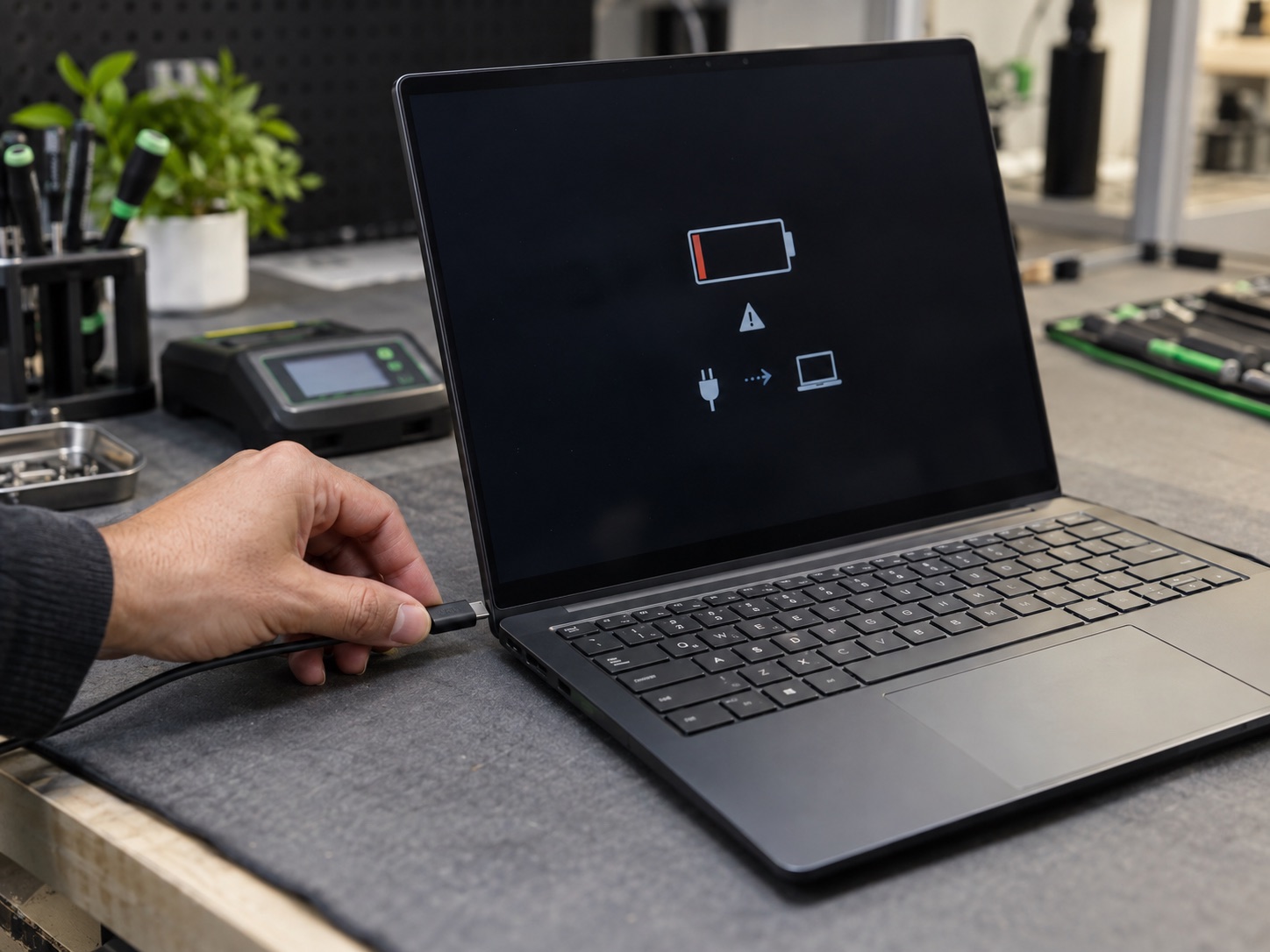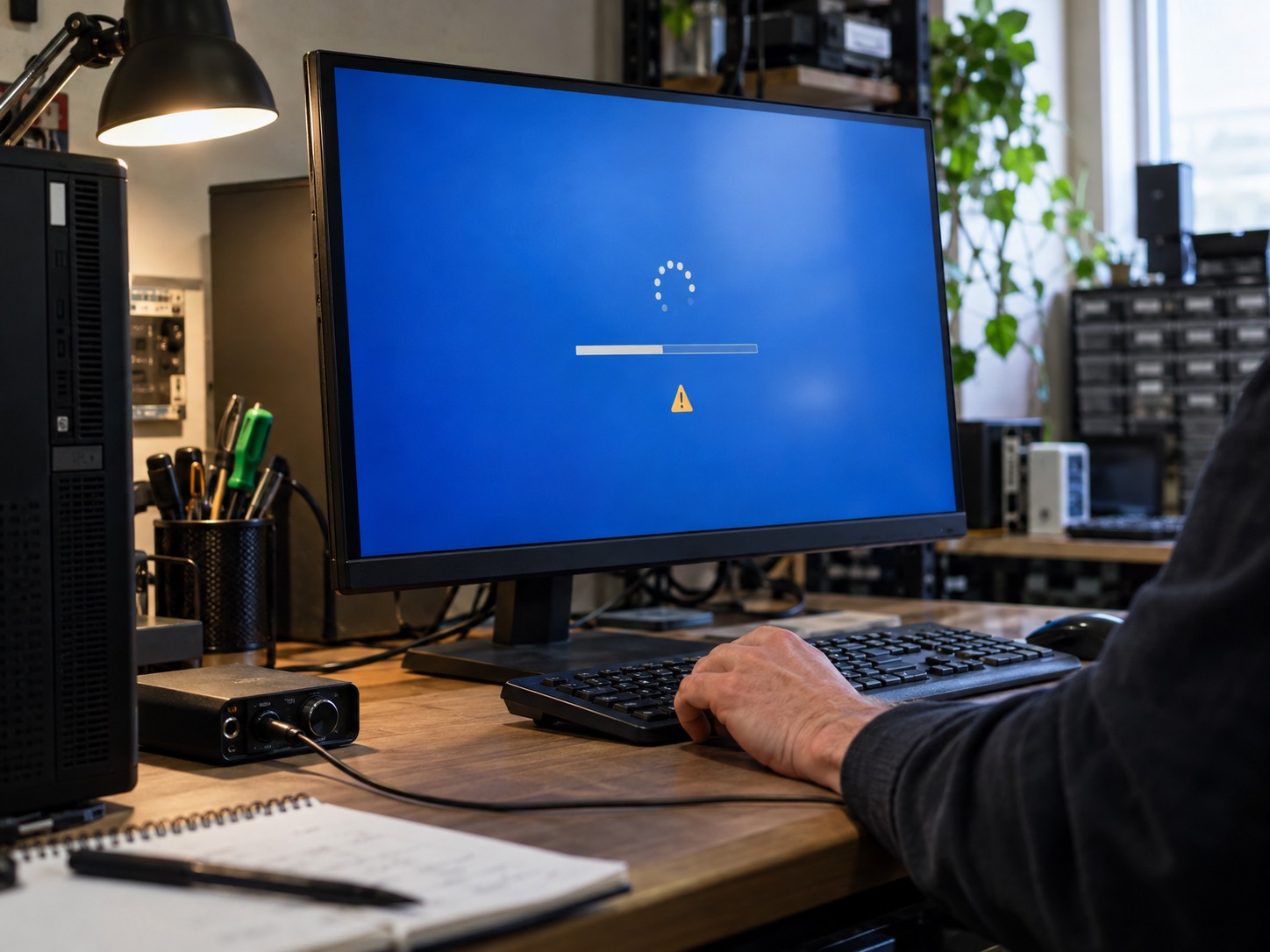


Slow computer driving you crazy? Here are the 12 fixes our Nashville bench uses every day, from startup cleanup to SSD upgrades, ranked by how much speed they really buy you.
Slowness is the most common complaint that reaches our bench in Hendersonville, and the most misunderstood. People assume a machine that has slowed down is simply an old machine. Usually it is not. Almost every slow computer we test has one specific resource out of headroom: the processor, the memory, the storage drive, or the cooling. Find which one and the fix is often free.
This guide follows the order we work in. Measure first, clear the free stuff, rule out the faults that only look like slowness, then upgrade the one part actually holding the machine back. It applies to Windows and macOS, and to every desktop, laptop and gaming rig on our computer and laptop repair bench.
Step One: Find The Bottleneck, Do Not Guess
Windows gives you the answer in Task Manager. Press Ctrl, Shift and Escape together, open the Performance tab, and watch it while the machine feels slow. On a Mac, open Activity Monitor and check the CPU, Memory and Disk tabs. You want to see which of the four readings is pinned while the other three sit idle.
The mistake is reaching for a cleanup tool before looking. If the disk sits at 100 percent because the drive is failing, deleting temporary files changes nothing. If memory is full because you run sixteen tabs and a video call on 8 GB, trimming startup programs buys you almost nothing.
| Symptom | What the monitor shows | Usual cause | The fix that works |
|---|---|---|---|
| Minutes to reach the desktop | Disk pinned for the first few minutes | Startup programs, or a spinning hard drive | Trim startup items, then fit an SSD |
| Freezes with a few apps open | Memory above 85 percent | Not enough RAM, so the system swaps to disk | Add memory |
| Loud fans, speed fades after ten minutes | Processor clock speed drops under load | Dust and dried thermal paste | Internal clean and fresh paste |
| Random long pauses, copies stall | Disk pinned, almost no data moving | A failing drive | Back up now, then replace the drive |
| Slow only in the browser | One browser process eating the processor | Extensions, or a hijacked browser | Remove extensions, then scan |
| Slow since one specific day | A background service running constantly | Stuck update, new software, or an infection | Let the update finish, then scan |
The reading that is pinned is the one to fix. Money spent on the other three changes nothing.
The Numbers We Use As Thresholds
- Memory above 85 percent during normal work means the machine is short of RAM, not short of cleanup.
- Free space under 15 percent of the system drive costs real speed, and under 5 percent both systems struggle.
- A disk pinned at 100 percent while moving a few megabytes a second is failing, not busy.
- A processor at 100 percent with nothing open is an update, an indexing job, or something you did not install.
The Thing Almost Everyone Gets Wrong
Registry cleaners, one click optimizers and driver updater tools do not make a computer faster. We see more machines harmed by them than helped: they disable services the system needs and often arrive bundled with advertising software. Windows and macOS already clean up after themselves. Treat any program selling speed by subscription as part of the problem.
The Free Fixes, In The Order We Run Them
1. Restart Properly, Not Just Shut The Lid
Windows fast startup means Shut Down does not fully reboot the system, so choose Restart instead. Plenty of machines that arrive for slowness have not truly restarted in weeks. A real restart releases leaked memory, ends hung processes and lets a pending update finish. It is the cheapest test there is.
2. Cut The Startup List
Every program that launches at boot holds memory for the rest of the day. In Windows, open Task Manager and sort the Startup apps tab by startup impact. On a Mac, open System Settings, then General, then Login Items. Disable updaters, game launchers, chat clients and printer helpers. Nothing gets uninstalled, it just stops starting itself.
3. Give The System Drive Room To Work
Both systems need free space for virtual memory, updates and temporary files, so keep 15 to 20 percent of the drive clear. Empty the recycle bin or trash, clear downloads, uninstall software you have not opened in a year, and move photo and video libraries to an external drive. Storage Sense and the macOS storage panel automate most of it.
4. Let The Updates Finish
A machine part way through an update crawls until it is allowed to finish. This is why a computer feels suddenly slow in the week after one: it is reindexing files, rebuilding caches and reapplying drivers in the background. Leave it plugged in, give it an hour or two, restart, then judge. Graphics driver updates fix real performance bugs.
5. Deal With The Browser
For many people the computer is not slow, the browser is. Forty tabs, six extensions and a video call is a heavy workload on any machine. Prune extensions to the ones you use, bookmark the tab hoard and close it, and check your homepage and default search engine. A search engine you did not pick is a malware symptom, not a preference.
Faults That Only Look Like Slowness
6. Malware And Unwanted Software
A computer that slowed down overnight, shows pop-ups, opens tabs you did not ask for, or runs its fan hard while idle may be working for someone else. Coin miners and adware consume whatever capacity is spare. Run a full scan, and if the infection returns after cleaning, it has a persistence mechanism a scanner will not reach. That is where professional virus and malware removal earns its cost: a clean machine with your files intact, rather than a wipe.
Most software-side slowness is settled without anyone driving anywhere. A remote support session at $100 per hour lets us work on the machine while you watch the screen, which suits cleanups, update repairs and startup work.
7. A Drive That Is Failing, Not Just Full
Hard drives rarely die without warning. They get slow first: long pauses, hanging file windows, a boot that takes minutes, copies that stall at 99 percent. That is a drive with bad sectors, and every hour of use makes it worse. Back up immediately, then have it tested. If files have already stopped opening, stop using the machine and ask about data recovery, which starts at $99 here and gets harder the longer the drive stays powered on.
8. Heat And Thermal Throttling
Processors slow themselves down when they get too hot. A laptop with dust packed into its heatsink, or a desktop whose thermal paste has dried out, runs fine for two minutes and then falls off a cliff. The tell is easy: the fans get loud at exactly the moment the machine gets slow. An internal clean and fresh paste often restores performance written off as age. We see it most on gaming laptops and desktops, which run hot by design.
9. Indexing That Never Finishes
Windows Search and Spotlight rebuild their index after a major update or a large file transfer, and an index that never completes holds a drive at full load indefinitely. On Windows, check Settings, Privacy and Security, then Searching Windows, and rebuild if the item count stops moving. On macOS, add the startup disk to the Spotlight privacy list, then remove it, which forces a clean rebuild. Excluding an external drive from indexing fixes plenty of stalls on its own.
Why Macs Slow Down In Their Own Way
Macs hit the same four limits, but the symptoms read differently: the spinning wait cursor, a Finder that stalls on a network volume, a startup disk warning dismissed for months. A full startup disk with a clogged fan is the most common Mac repair we handle that is not a screen or a battery. Memory on Apple Silicon is part of the chip, so storage, cooling and software are the only levers you have.
Upgrades That Actually Move The Needle
Once the free fixes are done and the machine is still slow, hardware is the limit. Two upgrades account for almost every real transformation we deliver.
| Upgrade | What it fixes | What changes day to day | Worth it when |
|---|---|---|---|
| SATA SSD replacing a hard drive | Every disk-bound delay | Boots in seconds, programs open at once | The machine still runs a spinning drive |
| NVMe SSD | Disk-bound delay on a modern board | Faster still on large files and projects | The board or laptop has a free M.2 slot |
| 8 GB to 16 GB of RAM | Freezing with several apps open | Tabs and apps stay open without stalling | Memory sits above 85 percent in normal use |
| Clean operating system install | Years of accumulated software friction | The machine behaves the way it did new | Cleanup helped a little but not enough |
| Internal clean and thermal paste | Throttling under sustained load | Speed holds instead of fading | Fans get loud as performance drops |
Every one of these is quoted before work starts, parts plus labor, and approved by you.
10. Fit An SSD
If the machine still boots from a spinning hard drive, this is the upgrade and nothing else comes close. A mechanical drive has to physically move a head to reach data, which is why an old laptop spends its first few minutes thrashing before the desktop is usable. A solid state drive has no moving parts and answers thousands of small requests in the time a hard drive serves a handful. We clone the existing system across, so files, programs and settings arrive unchanged and only the speed is different. SSD work and memory fitting make up the bulk of what our hardware upgrades bench does, and it is why five-year-old laptops leave here feeling new.
11. Add RAM
8 GB is the practical floor for current Windows and macOS, and 16 GB is where a machine stops fighting you. If the monitor shows memory above 85 percent while you work, the system is constantly shuttling data between RAM and the drive, and that is exactly the freeze people describe as the computer hanging for no reason. Before ordering anything we check what the board supports, how many slots are free, and whether the memory is soldered, because on many thin laptops it cannot be changed at all. A memory upgrade bought for the wrong machine is money gone, so that check comes first.
12. Reinstall The Operating System Cleanly
Years of installs, uninstalls, leftover services and half removed software leave friction that no cleanup tool reaches. A clean installation with your data preserved and drivers set up properly gives an older machine a genuine second life, and it pairs naturally with a new drive because the storage is being replaced anyway. If the computer is still on Windows 10, which stopped receiving security updates on October 14, 2025, this is also the moment to settle the Windows 11 upgrade rather than doing the same work twice.
What Not To Do
- Do not defragment an SSD. It achieves nothing and adds wear, and both operating systems already run the correct maintenance for solid state drives.
- Do not disable the page file or virtual memory to save space. That produces crashes, not speed.
- Do not run two antivirus programs at once. They fight each other and both slow the machine down.
- Do not keep working on a drive that is clicking, stalling or losing files. Slowness is the warning, data loss is the destination.
- Do not buy memory before confirming the machine can take it, and do not buy a whole new computer before finding out which part was actually slow.
When A Tune-Up Is Not The Answer
We would rather lose the sale than take money for a tune-up that cannot work. A twelve-year-old dual core laptop with 4 GB of soldered memory has a ceiling no cleanup can raise. A machine with a damaged board or a failed power circuit is not slow, it is dying, and speed is the wrong thing to be talking about. A computer that has already lost files needs recovery before it needs anything else. Our rule of thumb is the same one we apply to every repair: if the work costs less than half of an equivalent replacement, fixing it is the better buy, and when it does not, we say so plainly.
How This Works At The Shop
The diagnostic is $100 for PCs and Macs, or $125 for gaming systems, it covers up to one hour of real testing, and it is applied to the repair. What you get back is a specific answer, which of the four bottlenecks you have, and a fixed price to clear it. Tune-ups, cleanups and drive swaps are completed in-house, with timing confirmed once the work is understood.
No appointment is needed to drop a machine off. Hendersonville customers are usually here inside fifteen minutes, Gallatin is 12 road miles down SR 386, and Goodlettsville is about 7 miles the other way, close enough to fit a drop-off into a lunch break. Nashville is roughly 18 miles through the I-65 corridor, so rather than ask for two round trips we normally arrange pickup and delivery, and the same applies to Clarksville, Murfreesboro and Spring Hill.
Frequently Asked Questions
Why Is My Computer So Slow All Of A Sudden?
Sudden slowness has a trigger, which is what makes it the easiest kind to fix. In order of how often we find it: an update still finishing in the background, new software that added itself to startup, malware, a cooling fan that has clogged, or a drive that has started to fail. Note the day it changed and what happened that day, because that alone usually names the cause.
Does Adding More RAM Speed Up A Slow Computer?
Only when memory is the bottleneck. If your monitor shows memory above 85 percent while you work normally, more RAM removes the freezing straight away. If memory sits at 40 percent and the disk is pinned, extra RAM changes nothing and the drive is the real problem.
Will An SSD Really Make My Old Laptop Faster?
If the laptop still uses a spinning hard drive, yes, dramatically. It is the single most effective upgrade available for an older machine: boots in seconds, programs open immediately, and the constant waiting disappears. We clone the existing system over so nothing changes except the speed.
How Much RAM Do I Need In 2026?
16 GB is the comfortable standard for everyday multitasking, 8 GB is workable for light browsing and documents, and 32 GB pays off for gaming, video and photo work. We confirm what your specific machine supports before recommending anything, since many thin laptops and all Apple Silicon Macs have memory that cannot be changed.
Why Is My Computer Slow After A Windows Update?
After a feature update, Windows reindexes files, rebuilds caches and reapplies drivers in the background, and that can take an hour or more on a busy machine. Leave it powered on, restart properly, then judge it. If it is still slow a day later, look at graphics drivers and the startup list, both of which an update can quietly change.
Do PC Cleaner And Registry Repair Programs Work?
No, and several actively cause harm. They disable services the system needs, they frequently install advertising software alongside themselves, and the registry has not been a meaningful performance factor for many years. Everything they claim to do is already handled by Windows Storage Sense or the macOS storage tools, at no cost.
How Long Should A Computer Last Before It Gets Slow?
A well kept machine should stay usable for around five to eight years, and desktops often go longer because they are easier to clean and upgrade. Getting slow at year three is not age, it is a specific fault or a bottleneck worth testing for.
Is A Tune-Up Worth Paying For?
When it is the right fix, yes, and when it is not, testing says so before you spend. Slowness caused by a failing drive, a throttling cooling system or hardware that has reached its ceiling cannot be tuned away, and learning that early protects both your data and your money.
Make It Fast Again
Book a diagnostic online, call or text 615-387-9454, or bring the machine to 110 Sanders Ferry Rd, Suite 11 in Hendersonville. Tell us what it does and when it started, and we will tell you which bottleneck you have before you spend anything on parts. Cash, CashApp, Venmo, Apple Pay and Zelle carry no fee, and cards carry 3.5 percent.
GeekzUP Team
Veteran-owned computer repair in Hendersonville, TN. Serving Nashville and Middle Tennessee since 2012.